
The Preacher's Lectionary Notebook - God Loves Ishmael Too
The Fourth Sunday after Pentecost (Year A)

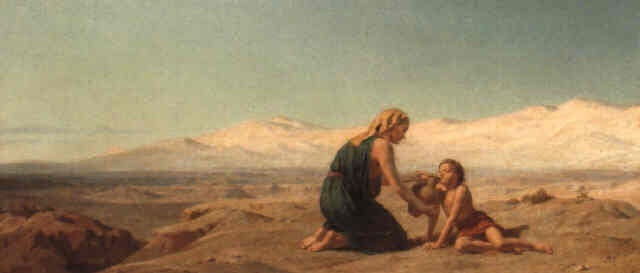
“Hagar and Ishmael in the Desert,” Frederick Goodall (1866)
The passage begins with a celebration. Isaac is grown and he is old enough to be weaned and Abraham has a great feast. What should have been a joyous family event turns into a conflict. Sarah sees Ishmael, son of Hagar, talking to Isaac in a way that troubles her. The text never explains what Ishmael is doing, but Sarah sees him as a threat to Isaac’s future inheritance. As a result, she demands that Abraham send Hagar and Ishmael away.
We can easily imagine how painful that request must have been for Abraham. Ishmael was his son too, Isaac was the child of God’s promise, and Abraham loved Ishmael. Abraham was very troubled by his son, the text says. Even the great heroes of faith have personal struggles. Abraham was caught between the demands of Sarah and his love for Ishmael. But God tells Abraham to listen to Sarah and reminds him that Isaac is the one through whom the promises of the covenant will be kept. God also does not forget Ishmael. He promises that Ishmael will be a great nation as well because he is Abraham’s descendant.
The next morning Abraham gives Hagar bread and water and sends her and Ishmael into the wilderness. The scene is heartbreaking. Hagar is once again in the desert alone with her son. At last their water runs out and the situation becomes dire. Hagar places Ishmael under a bush and moves a short distance away because she cannot bear to see him dying. She starts to weep. The terror and helplessness of a mother is seen when all human resources are exhausted. Hagar has no plan left and no visible source of hope. F.B. Meyer writes,
Poor Hagar! She thought that she had given Abraham his heir, but now she found herself and her boy outcasts on the desert waste… Cry to God, He will open fountains in the middle of your deserts… Beneath their sad lot a divine purpose was running (Commentary on Genesis 21:8–21).
In such a situation is where God’s grace is most evident. God sees the boy cry and sends an angel to reassure Hagar. The angel tells her not to be afraid because God knows the boy’s voice. God sees people who are forgotten, abandoned, and overlooked. Hagar was not part of the covenant line through Isaac, but she was known and loved by God. Divine compassion extends beyond the boundaries we often create.
God then opens Hagar’s eyes and she notices a well of water nearby. The well was probably there all along, but in her despair she could not see it. We are in similar situations from time to time and the situation seems hopeless until God helps us recognize the provision that is already there. The story ends with God being there for Ishmael when he grew up in the wilderness and became a great archer. God’s promise was fulfilled, and Ishmael’s future was secured.
God is faithful to his promises and cares for those who feel cast aside. The story contains sorrow, conflict, and uncertainty but it ultimately points to a God who hears cries in the wilderness and provides hope when none seems possible.
FOR FURTHER EXPLORATION
Why do you think Abraham struggled so much with Sarah’s request to send Hagar and Ishmael away, and what does this reveal about his character?
What does God’s care for Hagar and Ishmael teach us about how God responds to people who feel forgotten, rejected, or alone?
Have there been times when a difficult situation seemed hopeless until an unexpected solution appeared, and how does Hagar’s experience help us think about those moments?