
The Preacher's Lectionary Notebook - Connecting the Texts
The Fourth Sunday after Pentecost (Year A)

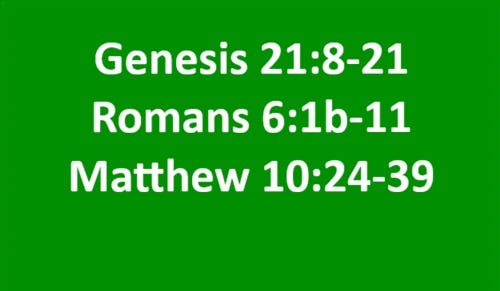
Genesis 21:8-21; Romans 6:1b-11; Matthew 10:24-39
The three texts of interest this week discuss the cost of faithfulness and how God transforms fear and loss into life. They are very different narratives, but they have the same message. With God’s purpose, life can be hard but God is there and keeps his promises when the path is difficult.
In Genesis 21, Hagar and Ishmael are rejected and displaced. When there is conflict in Abraham’s family, Hagar and her son are sent into the wilderness with inadequate food and water. When their water runs out, Hagar feels hopeless. She thinks of death and cannot bear to see her son suffer. God, however, is listening to Ishmael’s cries and is compassionate to them in this crisis. God opens Hagar’s eyes to a well of water and renews the promise that Ishmael will become a great nation. The wilderness becomes a place, not of death, but of unexpected deliverance. What seems to be the end of the story is the beginning of a new future because God is faithful.
Jesus’ words in Matthew 10 reflect a similar truth. He prepares his disciples for the difficulties of following him. And rather than offer comfort and acceptance, Jesus warns that disciples are to experience opposition, misunderstanding, and even division in their own families. God knows even the smallest details of their lives, including the number of hairs on their heads. The God who watches over sparrows certainly watches over his people. Just as Hagar did in the wilderness, the disciples are called to trust God’s care even when circumstances seem threatening.
Paul’s teaching in Romans 6 gives a theological basis for that kind of courage. Believers are united with Christ through baptism both in death and resurrection. The Christian life is one of having a new set of beliefs and moral habits. It is also about participating in Christ’s victory over sin and death. We have died with Christ, and we have risen up with him to walk in newness of life. This new identity alters how we view suffering and sacrifice. Because Christ has already conquered death, fear no longer has the final word.
In these passages, we see a pattern. Hagar and Ishmael appear abandoned but discover God’s provision. The disciples are warned of persecution but are assured of God’s continual care. Christians are called to die with Christ, but death leads to resurrection life. God works in scary situations and in hopeless ones. The message isn’t that faith is enough to eliminate hardship. Rather, faith encourages us to believe that when we are in the midst of hardship, God is there and God is leading us to life.
When we are in the wilderness, in a place of opposition from people who oppose us because of our faith or where we live out our new identity in Christ, we are reminded that God is more trustworthy than fear. The God who rescued Hagar and the disciples and raised Jesus from the dead still guides all of us today.
FOR FURTHER EXPLORATION
What fears do Hagar’s experience and Jesus’ words about persecution have in common?
How does Paul’s teaching about dying and rising with Christ help us face difficult situations?
What does it mean to trust God’s care when we cannot yet see a solution to our problems?