
The Preacher's Lectionary Notebook - When Righteousness Steps into the River
The First Sunday after the Epiphany: The Baptism of the Lord (Year A)

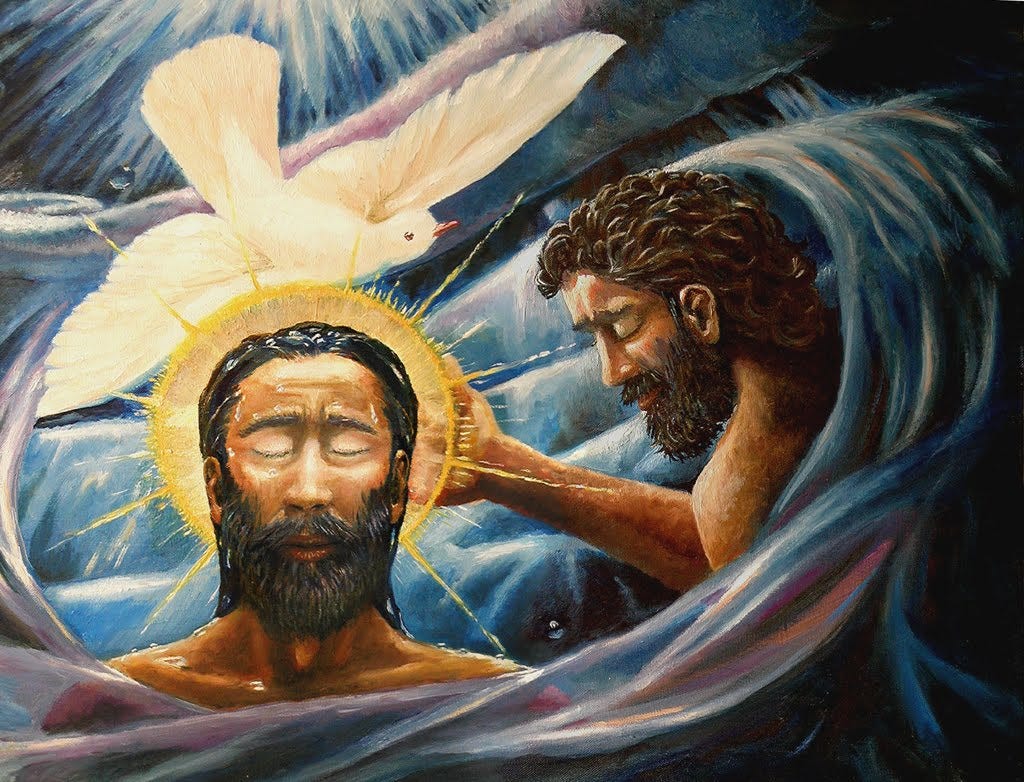
Jesus comes to John the Baptist to be baptized in the Jordan. We can almost picture it— the Jordan flowing slowly, reeds rustling along the banks, and John preaching repentance to anyone who would listen, suddenly confronted by someone he knew was different—someone holy, someone above him. John and Jesus were cousins. John knew Jesus personally. What Jesus wants seems unnecessary.
Jesus steps out of the crowd and approaches John. John, recognizing the weight of the moment, hesitates. “I need to be baptized by you,” he says, “and you come to me?” It’s a human moment, right? Even John, full of zeal for righteousness, can sense that Jesus doesn’t need this ritual. Baptism, after all, was a sign of repentance, of turning from sin. How could Jesus be in need of what John has to offer?
There’s a quiet resolve in his voice: “Let it be so now; it is proper for us to do this to fulfill all righteousness.” It’s a line that alone says something more profound. Jesus isn’t baptized because he’s in need of cleansing. He’s baptized to be joined with humanity, to be fully immersed in the human story, and to prepare for what his ministry will accomplish.
So John relents. Jesus wades into the water and John follows him, and then it occurs. He is baptized. His ascent from the river leads the heavens to open. The imagery here is steeped in Israel’s Scriptures—a tearing out through the ordinary into the extraordinary. As a dove comes down, the Spirit of God settles on Jesus—it’s not just a symbolic gesture. It is public confirmation. The Spirit resting on him is the initiation of his public ministry showing this is the one empowered by God. And there’s the voice, ringing out across the waters, personal and resonant: “This is my Son, whom I love; with him I am well pleased.” Imagine being there. That proclamation is much more than a statement for Jesus; it is an exemplar for all of us of how to live in alignment with God’s will. It is affirmation, identity, and mission all in one.
Here, in these few verses, Matthew boils down some heavy theology to a digestible story. Baptism, the Holy Spirit, God’s consent — it’s there. But it is also deeply relational. Jesus is coming into the human experience with everyone else who is going to follow him. There’s humility, obedience, divine affirmation threaded in. That moment is still a call to both identification with the human story and openness to the Spirit’s work for pursuing God. Jesus doesn’t just instruct; he participates. He shows what it looks like to be faithful, obedient to God’s vision and to accept his call and his plan within the humble midst. This passage establishes a foundation for anything that follows in Jesus’ ministry and shows that the path forward of God’s agenda is a balance of humility and divine endorsement.
FOR FURTHER EXPLORATION
What does Jesus’ insistence on being baptized reveal about the nature of obedience and solidarity with humanity, even when obedience seems unnecessary or misunderstood?
How does the public affirmation of Jesus’ identity before his ministry begins challenge modern assumptions about worth, achievement, and calling?
In what ways does the presence of the Father’s voice, the Son in the water, and the Spirit descending shape how this passage is understood as a foundational moment for Christian faith and practice?