
The Preacher's Lectionary Notebook - Raised. Seen. Alive.
The Second Sunday of Easter (Year A)

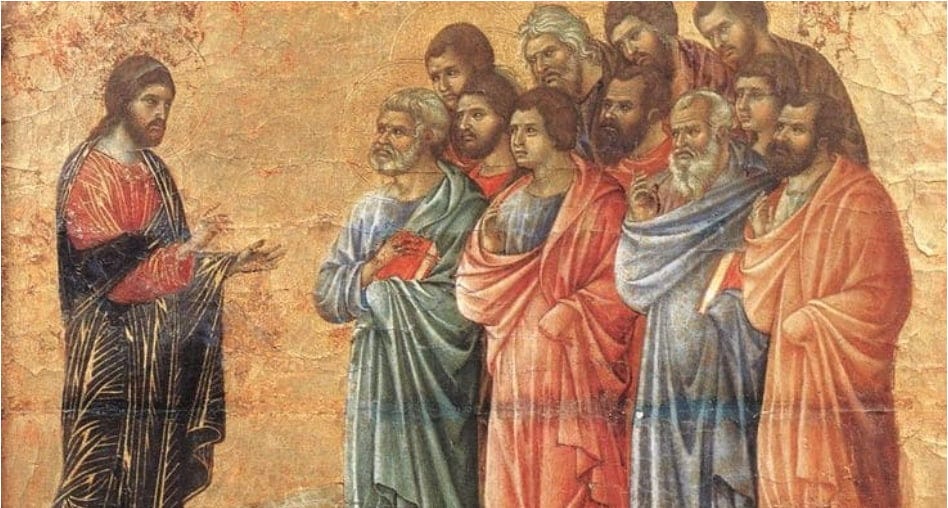
“The Appearance on the Mountain in Galilee,” Duccio di Buononsegna
Peter stands up with a new steadiness that feels unfamiliar even to those who knew him before. The same voice that once faltered around a charcoal fire now carries across a crowd, not defensive, not evasive, but grounded. Something has shifted. The noise of Pentecost still lingers in the air, but Peter does not try to explain everything at once. Instead, he points straight to Jesus. Not an idea about Jesus, not a softened version, but the real story as it unfolded in public view. Jesus of Nazareth, a man whose life bore the unmistakable imprint of God through deeds of power and signs that people had seen with their own eyes. This was not hidden in a corner. This was out in the open.
Yet Peter does not let the crowd remain at a safe distance from the story. The tone changes. The words press closer. This Jesus, handed over according to God’s purpose, was crucified and killed. This is not just history being recited. It is a confrontation. Human hands carried out what divine purpose allowed, and somehow both truths stand together without canceling each other. Responsibility is not erased by mystery. The cross is not softened into something symbolic or distant. It is named for what it was.
But Peter does not stop there, because the story does not stop there. God raised Jesus up, releasing him from death itself. In resurrection, chains were snapping, a grip was loosening. Death, which seemed so final, is described as incapable of containing him. It is a reversal that reorders everything. The crowd had seen death do its work before. This was different. This was God refusing to let death have the last word.
To make sense of it, Peter reaches back into the words of David. The ancient psalm becomes a lens through which the present moment comes into focus. David spoke of a confidence that God would not abandon the faithful one to the grave or let decay have the final say. At first, those words may have sounded like hope stretched to its limits, maybe even poetic exaggeration. But now Peter reads them differently. David died and was buried, and his tomb remained. The words were pointing beyond him. They were waiting for fulfillment.
So Peter draws the line clearly. David saw ahead and spoke of the resurrection of the Messiah. Jesus is that fulfillment. Not abandoned. Not left to decay. Raised. Seen. Alive. The testimony is rooted in witness and memory and the shared realization that something decisive has happened. The story of Jesus is not just about what was done to him, but about what God did for him and through him.
In this moment, Peter’s courage feels less like personal bravery and more like participation in something larger. The message carries both confrontation and hope, judgment and promise. The same crowd that heard about crucifixion now hears about resurrection. The same story that exposes human failure also reveals divine faithfulness. It is a message that refuses to leave things as they were.
FOR FURTHER EXPLORATION
What does it mean that both human responsibility and God’s purpose are present in the crucifixion?
Why is the resurrection essential to Peter’s message about Jesus?
How does Peter use the words of David to explain what happened to Jesus?