
The Preacher's Lectionary Notebook - Exile Is Not Forever
The Second Sunday after Christmas (Year A)

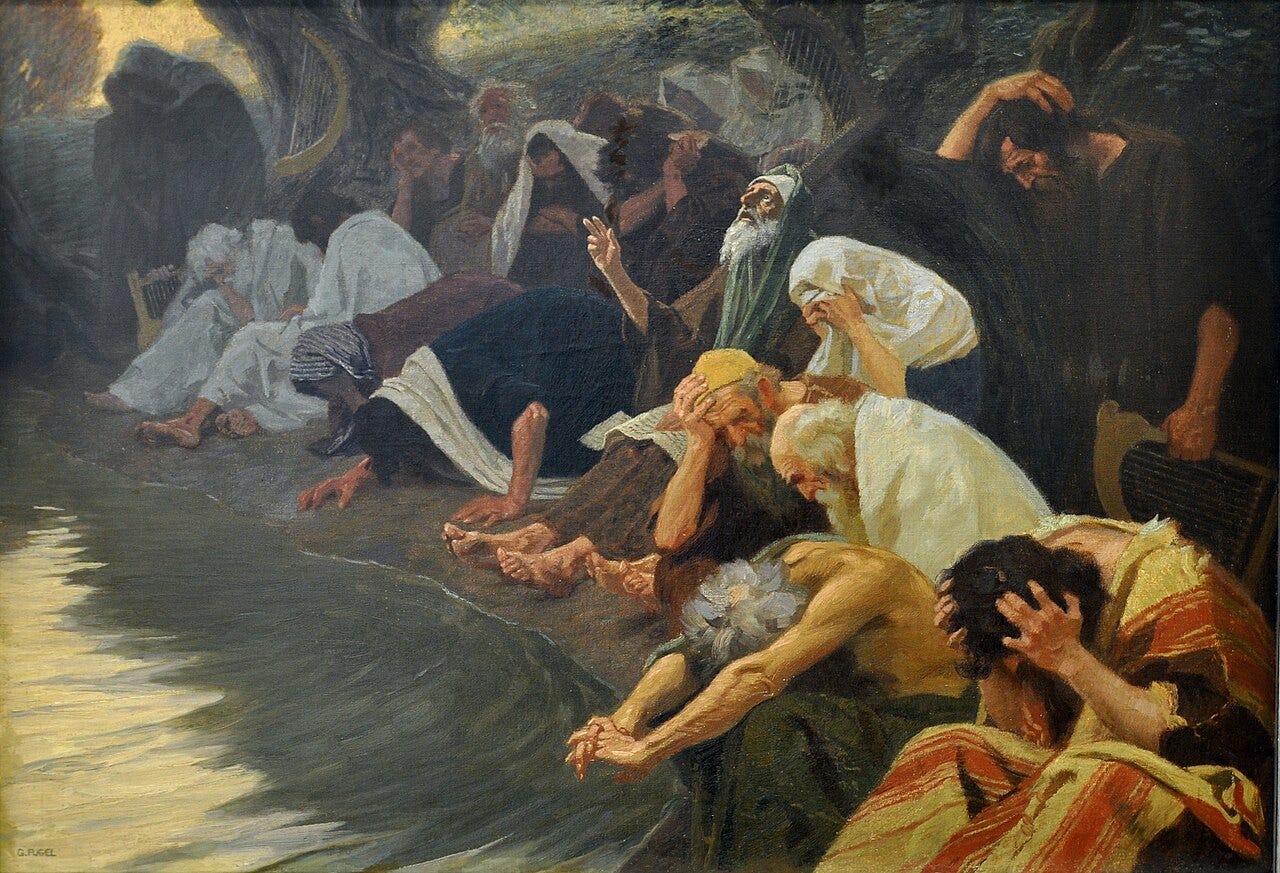
Waters of Babylon by Gebhard Fugel (1920)
This text is, at first, awkward if searching for Christmas, with no angels in the sky, no manger, or shepherds. And yet, if Christmas is about more than decorations and nostalgia, it’s about this kind of promise. God stepping into a story that seems broken and transforming mourning into joy. Jeremiah is speaking to a people who know exile, loss, and disappointment firsthand. Their world has fallen apart, and the future looks thin and uncertain. Into that reality comes a word that refuses to let despair have the final say. “Sing aloud with gladness,” the prophet says—not because everything is already fixed, but because God has decided not to abandon the people God loves.
The imagery in this passage is tender and surprisingly intimate. God gathers the people like a shepherd, bringing back the blind, the lame, those with child, and those in labor. No one is too weak, too slow, or too burdened to be included in the return home. This is not a triumphal march of the strong and successful; it is a slow procession of the vulnerable. That sounds a lot like Christmas, where God does not arrive in strength or spectacle but in a child, dependent and small. Christmas declares that God’s redemption moves at the pace of those who struggle, not at the pace of empire or efficiency.
Jeremiah also speaks of weeping that turns into consolation. The people come back in tears, but they are met with comfort. That emotional turn is central to the season of Christmas, especially for those who feel the ache of absence more sharply this time of year. The joy of Christmas is never a denial of grief; it is joy that dares to exist alongside it. Jeremiah’s promise that sorrow will give way to gladness is echoed in the Christmas story, where light shows up not by pretending the darkness is gone, but by shining directly into it.
There is also the theme of abundance running through the passage. Grain, wine, oil, flocks, and herds overflow. Life is not merely restored; it is renewed. The people are described as a “watered garden,” no longer parched or depleted. Christmas carries that same sense of divine generosity. God does not offer a minimal fix or a temporary patch. Instead, God gives God’s own self. In the birth of Jesus, God plants life again in dry ground, promising that scarcity and emptiness do not define the future.
Finally, Jeremiah talks about joy handed down through generations: young and old all celebrating, priests content, people filled with goodness. Christmas tends to pull generations into the same narratives — even if they tell them differently. The carols, the readings, the rituals — these are echoes of an ancient promise still being fulfilled in different ways. Jeremiah 31 reminds us that Christmas is not just about a moment long ago, but about God’s ongoing commitment to gather, heal, and rejoice with a weary world. It is the promise that exile is not forever, tears are not wasted, and joy, somehow, is still possible.
FOR FURTHER EXPLORATION
How does Jeremiah 31:7–14 deepen our understanding of the way God brings hope and restoration to people in broken or difficult circumstances, and how can that inform the way we experience Christmas today?
In what ways does the imagery of God gathering the vulnerable and turning sorrow into joy connect with the birth of Jesus, and what does that suggest about God’s priorities in redeeming the world?
How can the themes of abundance, renewal, and intergenerational joy in this passage challenge or reshape the way we celebrate Christmas in a culture often focused on materialism and individualism?