
The Preacher's Lectionary Notebook - Hunger, Silence, and Dust
The First Sunday in Lent (Year A)

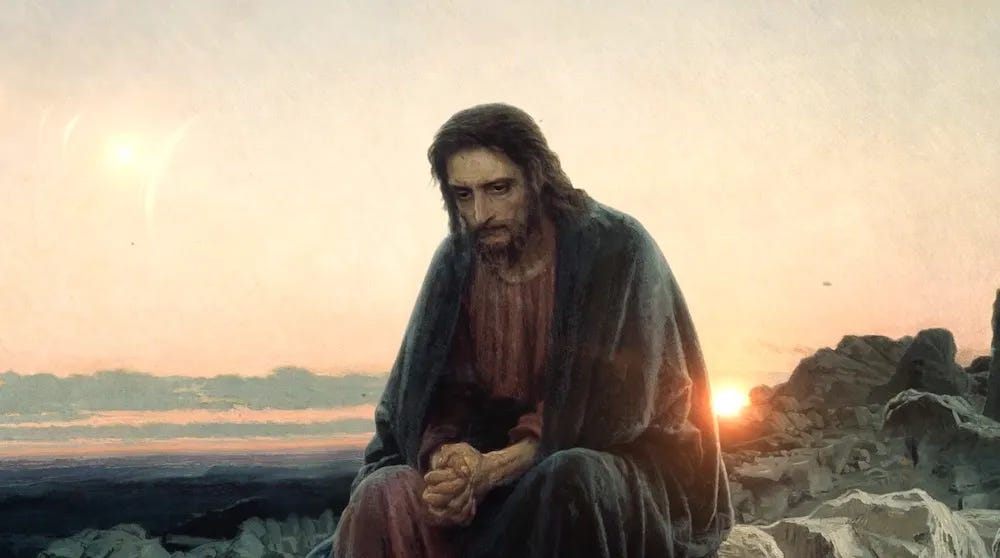
Matthew chapter 4 opens with hunger, silence, and dust. Jesus has just been baptized, heaven opened, the Spirit descended, the voice spoke, and then immediately that same Spirit leads him away from the river and into the wilderness. No applause, no momentum, no followers yet. Just rocks, heat, and forty long days of emptiness. The story refuses to let us imagine spiritual clarity without vulnerability. Before Jesus teaches anyone how to live, he must first face what kind of Messiah he will be when no one is watching and nothing is easy.
The first temptation is almost tender in its cruelty, “If you are the Son of God, command these stones to become bread.” Jesus is starving. This isn’t a theoretical test; it’s a bodily one. The temptation isn’t simply about bread but about using power to erase dependence. Why wait? Why trust? Why endure? Jesus’ response does not deny hunger; it refuses to let hunger dictate. He draws upon Israel’s story, “One does not live by bread alone.” Life is more than appetite, even legitimate appetite. Here, trust in God is learned not by bypassing the ache but by embracing it.
The second temptation shifts from the stomach to the ego. The devil takes Jesus to the pinnacle of the temple, the very center of religious life, and invites him to jump, “God will catch you,” quoting Scripture as if faith were a stunt. It is the lure of spectacle, of coercing God into a performance, of confusing trust with proof on demand. Jesus refuses. Faith is not a prop, and obedience is not a high-wire act. God does not need testing; trust is not measured in dramatic leaps.
The third temptation is nakedly political. All the kingdoms of the world, with their glory, lie before him. No cross, no suffering, no slow, patient work of love, just power now, if he will bow. This is the lure of relevance without faithfulness, influence without integrity. Jesus draws a hard line: worship belongs to God alone. His kingdom cannot be built on borrowed power or compromised loyalty.
Jesus resists not with flash or force but with memory and fidelity. He does not invent clever arguments; he remains rooted in Scripture, in Israel’s long, often faltering struggle to trust God in the wilderness. Where Israel failed, Jesus holds fast. The wilderness becomes the place where his vocation is clarified. He will not be a magical bread maker, a religious stuntman, or a political strongman. He will be the Son who trusts, obeys, and waits.
When the devil departs, angels come, not before. Provision follows faithfulness, not the other way around. Matthew 4:1–11 reminds us that the real battle is often quiet, internal, and unseen. It is about what we choose when shortcuts are offered, when hunger speaks loudly, and when power seems easier than trust. The wilderness does not break Jesus; it confirms him.
FOR FURTHER EXPLORATION
What does Jesus’ refusal to turn stones into bread teach us about how to handle our own legitimate needs and desires?
How do the temptations in the wilderness reveal different ways power can distort faith?
In what ways might the “wilderness” be a necessary place for clarifying who we are and what we’re called to be?